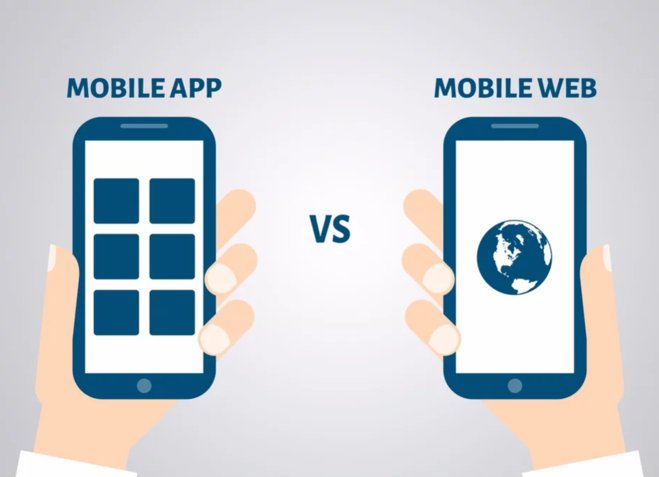
The debate about what's more effective — a website or a mobile app — was settled long ago. Yes, a website remains a company's business card. But if your goal is not just an online presence, but real sales and profit growth, a mobile app today is unrivaled. Especially in an environment where marketplaces dominate the market and the cost of customer acquisition through advertising is hitting record highs.
A website operates on a "visit-buy-leave" principle. A customer comes, makes a purchase, and disappears — until you spend your budget to attract them again.
A mobile app works differently. It lives on the user's smartphone screen 24/7. This means:
Statistic: Mobile app users make repeat purchases 3.2 times more often than website visitors.
2. The App: Your Independence from Marketplaces
Today's market situation is tough: Yandex, Wildberries, Ozon, and other marketplaces have monopolized not only sales but also search results. To rank at the top, you have to pay — a lot and constantly. Plus, you share a commission (up to 25%) and compete with thousands of similar products.
A mobile app is your own distribution channel where:
This isn't about competing with marketplaces. It's about refusing to play by their rules.
3. The Lowest Cost per Transaction on the Market
Let's compare the Customer Acquisition Cost (CAC) across different channels (2026 data):
ChannelCost per Acquisition (CAC)
Contextual Ads (Yandex/Google)
800–1,500 ₽
Targeted Ads (VK/Telegram)
600–1,200 ₽
SEO (Long-term investment)
400–800 ₽
Marketplaces (Ads + Commission)
1,000–2,000 ₽
Mobile App (Post-installation)
50–150 ₽
Why is it so low? Because after installing the app, you no longer pay for each visit. The customer opens the app on their own — out of habit, from a notification, based on need. Every interaction is free.
The ROI of a mobile app pays off on average in 4–6 months. After that — it's pure profit from repeat sales.
Conclusion: App vs. Website Is Not a Choice, But an Evolution
A website operates on a "visit-buy-leave" principle. A customer comes, makes a purchase, and disappears — until you spend your budget to attract them again.
A mobile app works differently. It lives on the user's smartphone screen 24/7. This means:
- Push notifications deliver your offers directly — bypassing social media algorithms and email spam filters.
- Personalized recommendations based on purchase history increase the average order value by 25–40%.
- Loyalty grows automatically — the more often a customer opens the app, the less chance they'll go to a competitor.
Statistic: Mobile app users make repeat purchases 3.2 times more often than website visitors.
2. The App: Your Independence from Marketplaces
Today's market situation is tough: Yandex, Wildberries, Ozon, and other marketplaces have monopolized not only sales but also search results. To rank at the top, you have to pay — a lot and constantly. Plus, you share a commission (up to 25%) and compete with thousands of similar products.
A mobile app is your own distribution channel where:
- You don't pay marketplace commissions.
- You control prices, promotions, and assortment yourself.
- You are independent of ranking algorithms and platform rules.
- You build direct relationships with the customer — no intermediaries.
This isn't about competing with marketplaces. It's about refusing to play by their rules.
3. The Lowest Cost per Transaction on the Market
Let's compare the Customer Acquisition Cost (CAC) across different channels (2026 data):
ChannelCost per Acquisition (CAC)
Contextual Ads (Yandex/Google)
800–1,500 ₽
Targeted Ads (VK/Telegram)
600–1,200 ₽
SEO (Long-term investment)
400–800 ₽
Marketplaces (Ads + Commission)
1,000–2,000 ₽
Mobile App (Post-installation)
50–150 ₽
Why is it so low? Because after installing the app, you no longer pay for each visit. The customer opens the app on their own — out of habit, from a notification, based on need. Every interaction is free.
The ROI of a mobile app pays off on average in 4–6 months. After that — it's pure profit from repeat sales.
Conclusion: App vs. Website Is Not a Choice, But an Evolution
Ready to stop paying for every click?
A mobile app is not a trend. It's a business tool that reduces dependence on external channels, increases loyalty, and makes every transaction cheaper.
We develop turnkey mobile apps: from idea to publication in App Store and Google Play. Integration with 1C, CRM, and payment systems — all included in the price.
📞 Get a development cost and timeline estimate for your mobile app — we'll prepare a commercial proposal within 24 hours, including a forecast for reducing your cost per transaction by 60–80%.
A mobile app is not a trend. It's a business tool that reduces dependence on external channels, increases loyalty, and makes every transaction cheaper.
We develop turnkey mobile apps: from idea to publication in App Store and Google Play. Integration with 1C, CRM, and payment systems — all included in the price.
📞 Get a development cost and timeline estimate for your mobile app — we'll prepare a commercial proposal within 24 hours, including a forecast for reducing your cost per transaction by 60–80%.